
Primary Source Analysis
Generate source analysis assignments that guide students through authenticity, bias, historical context, and reliability.
Join our Facebook community. Join our Facebook community for back-to-school ideas and educator support. Join now
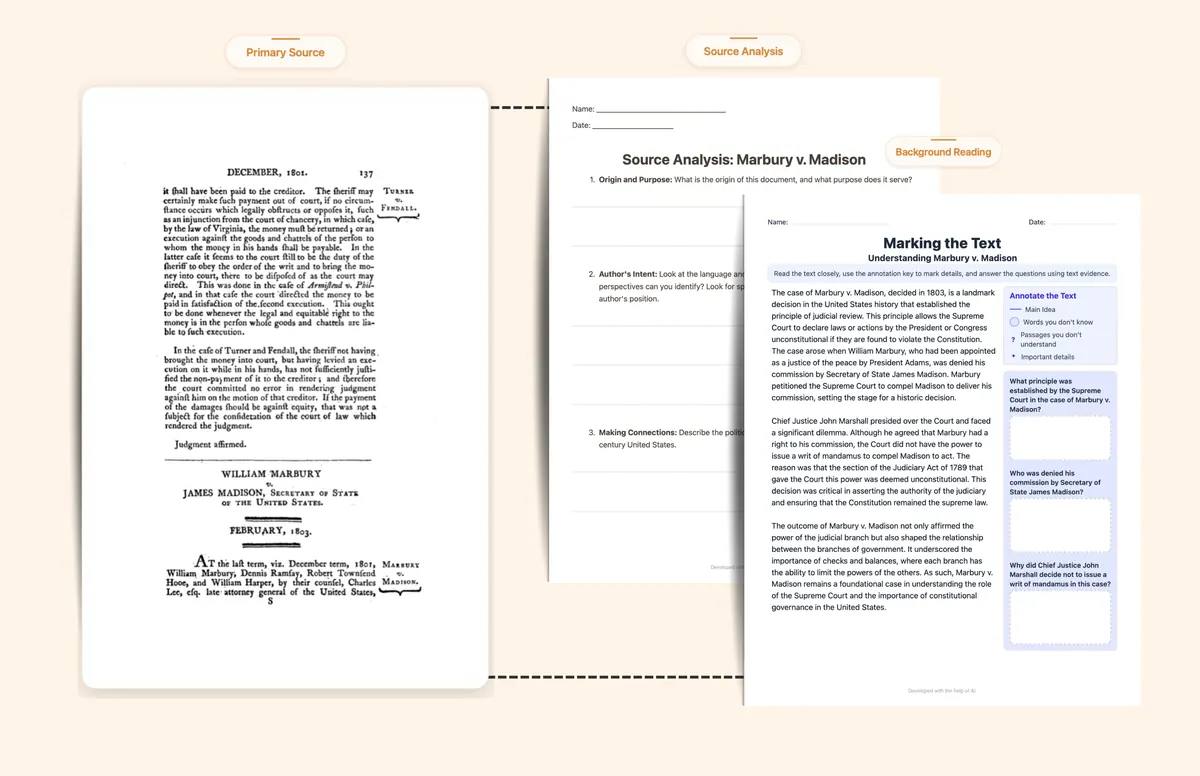
Generate source analysis assignments that guide students through authenticity, bias, historical context, and reliability.
Create debate frameworks and Socratic prompts with scaffolds that promote rigorous, productive civil discourse.
Build background readings paired with annotation guidance plus comprehension and analysis questions.
Generate timelines, T-charts, and concept maps to help students compare perspectives and sequence events.
Design research assignments and analytic rubrics that support sourcing, note-taking, writing, and presentation.

Prepares a First Amendment unit with a background reading on landmark Supreme Court cases, a paired source set with opposing legal arguments, a source analysis guide, a debate framework, and an analytic rubric for written position statements.

Create high-quality, detailed rubrics to provide precise, actionable feedback. This tool fosters instructional clarity by breaking down tasks into specific criteria, supporting differentiation and helping students understand exactly where to focus their efforts for improvement.

The Debate tool provides a step-by-step framework for conducting organized, meaningful classroom debates on any topic. Drawing from best practices in critical thinking, communication, and classroom management, it ensures that students research thoroughly, argue respectfully, and analyze multiple perspectives. By promoting intellectual rigor and civil discourse, this format helps learners connect academic content to real-world issues and develop essential argumentation skills.

The Discussion Prompts tool produces three carefully designed, open-ended questions aimed at stimulating thoughtful dialogue and deeper understanding of a chosen topic. Each question challenges students to move beyond surface-level knowledge by analyzing, synthesizing, or evaluating concepts. By tying new information to prior knowledge or real-world experiences, these prompts become personally relevant and encourage learners to consider multiple perspectives.
The Research Project tool designs comprehensive, inquiry-driven research assignments that guide students through critical source evaluation, structured research, and effective communication of findings. This tool ensures students engage deeply with a topic, develop information literacy skills, and present their knowledge through a clear, well-supported presentation.

The Source Analysis Questions can be used to guide students through the systematic evaluation of primary and secondary sources. By engaging with structured questions, learners analyze authenticity, reliability, bias, and historical or contextual significance—essential skills in research, history, and media literacy.
Use this tool to construct a clear, structured outline of key points for any topic. Generate major headings identified by Roman numerals, then break each down with letters for sub-points, and finally add bullet points or numbered items to indicate specific details or examples. Perfect for student notes or essay planning, it encourages logical progression and provides a simple framework to attach declarative knowledge.

Create a "Marking the Text" activity that builds close-reading habits students can use in any class. Students annotate the passage for meaning (main idea, unfamiliar vocabulary, confusing sections, important details) and respond to questions using evidence from the text, turning reading into visible thinking. Customize with toggles for various 3-2-1 question sets aligned to your specific goal (Comprehension, Reflection, Analysis, Writing Prep, or Retrieval). A powerful annotation and reading comprehension graphic organizer for text analysis, vocabulary growth, and evidence-based responses across grade levels.

Create a T-Chart that gives students a simple structure for rigorous thinking. Using two simple columns, pros/cons, claim/evidence, cause/effect, or any pairing you choose. Ideal for character analysis, paired texts, scientific classification, and historical comparisons from elementary through high school. Add optional parenthetical hints to scaffold each column. Toggle on activities like ranking and evaluation (ranking each item, starring the most important item, and explaining why) and collaboration (compare with a classmate). A versatile T-chart graphic organizer template for discussion, writing prep, and critical thinking across K-12.
Start with an objective, a topic, or a source. Leave with classroom-ready materials you can teach from.